

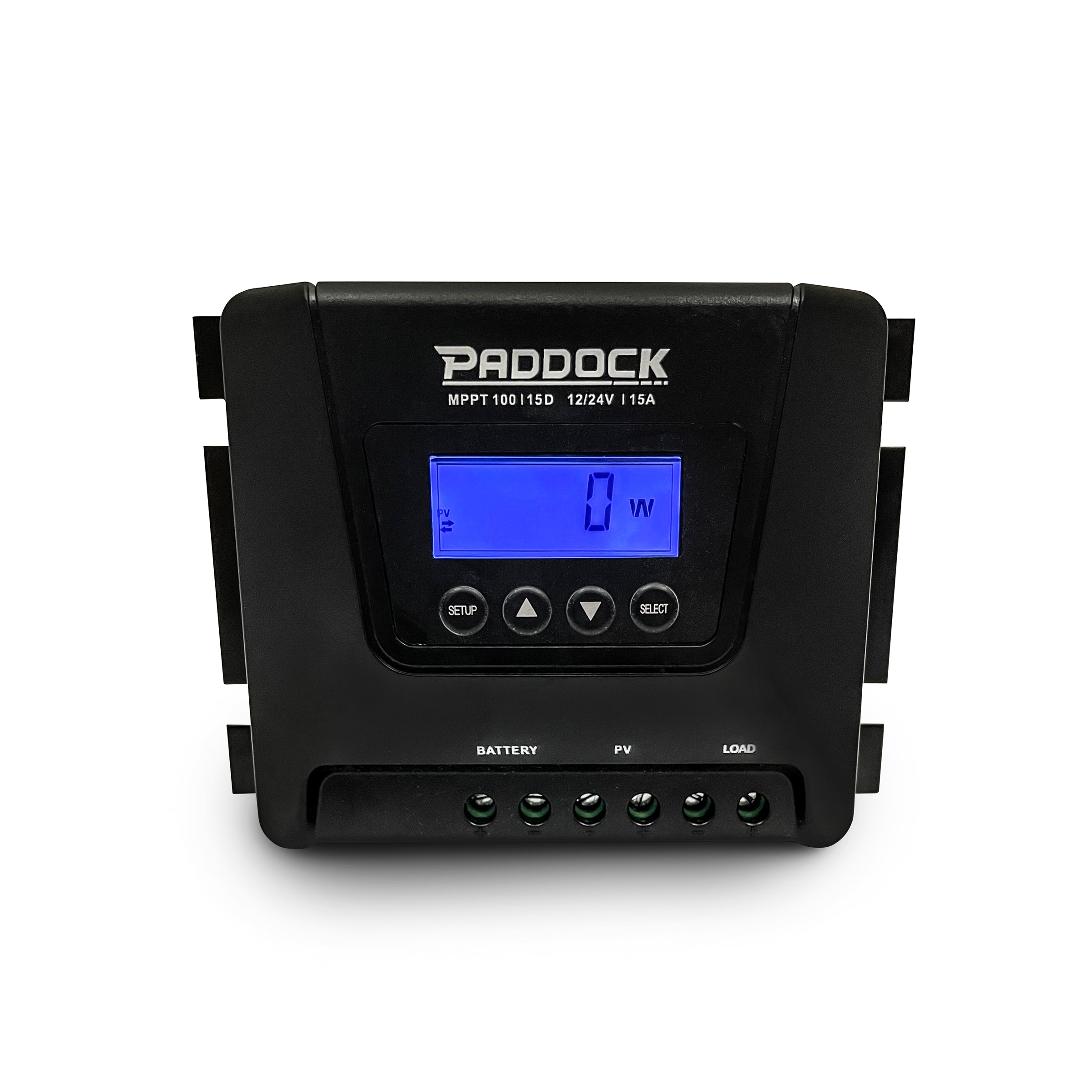
Paddock™ MPPT Solar Charge Controllers – 15A
Description
The Paddock™ MPPT Solar Charge Controller range is designed for efficient charging of 12V and 24V battery systems from compatible solar arrays. Available in 15A models, each controller features Maximum Power Point Tracking (MPPT), an integrated LCD display, multi-stage charging and built-in system protection.
With solar input capability up to 100V open circuit, maximum stated conversion efficiency of 98% and support for common battery types including AGM, GEL, flooded and lithium, these controllers are well suited to off-grid, farm, vehicle and remote power applications.

Paddock™ MPPT Solar Charge Controllers
A solar charge controller manages the power flowing from a solar array into a battery bank. The Paddock™ MPPT range is designed to regulate charging voltage and current while tracking the operating point of the solar panels for efficient energy conversion.
Two models are available:
- SMPPT100/15 – 15A output
Both models support 12V and 24V battery systems with automatic system voltage selection.
MPPT Solar Controller Features
- Maximum Power Point Tracking (MPPT) technology
- 12V / 24V automatic system voltage selection
- 15A and 30A output models available
- Up to 100V maximum PV open-circuit voltage
- Maximum stated efficiency of 98%
- Integrated LCD display
- 30-day history and data logging functions
- Multi-stage adaptive charging
- Adjustable absorption and float voltages
- Compatible with AGM, GEL, flooded and lithium battery charging profiles
- Low-voltage load disconnect / reconnect functionality
- Battery reverse-polarity protection via fuse
- Output short-circuit protection
- Over-temperature protection
- Operating temperature range from -30°C to +60°C
- Full rated output up to 40°C
- 2 year warranty
What Does MPPT Do?
Solar panel voltage and current vary with sunlight, temperature and operating conditions. An MPPT controller continuously adjusts its operating point to extract useful power from the solar array while converting it to the voltage required by the battery system.
This can provide better energy utilisation than basic PWM-style charging systems, particularly where panel voltage is significantly higher than battery voltage or where solar conditions vary throughout the day.
Up to 98% Conversion Efficiency
The Paddock™ controllers have a stated maximum conversion efficiency of 98%.
The controllers operate without a cooling fan and are rated to provide full output current at ambient temperatures up to 40°C. Output derating applies at higher temperatures up to the stated maximum operating temperature of 60°C.
12V & 24V Battery Systems
The SMPPT100/15 automatically detect and operate with compatible 12V or 24V battery banks.
Correct system sizing is important because the allowable solar array power changes with battery voltage.
Compatible Battery Types
The charge controller can be configured through the LCD interface to suit a range of common battery types and charging profiles.
Compatible battery types include:
- AGM
- GEL
- Flooded lead-acid
- Lithium
Always confirm the charging voltage settings required by the battery manufacturer before commissioning the system.
How to Read the Controller Model Number
The controller model number provides a simple indication of its primary electrical ratings.
For example, 100/30 means:
- 100 – maximum stated PV open-circuit voltage of 100V
- 30 – maximum charge output current of 30A
The same principle applies to the 100/15 model.
Choosing the Correct Controller Size
The controller should be sized according to both the solar array and the battery bank voltage.
For example, a controller rated to 15A cannot deliver more than its maximum charge current even if a larger solar array is connected. The solar array must also remain within the controller's stated PV power and voltage limits.
Maximum stated PV power for the supplied models is:
- SMPPT100/15: 200W @ 12V / 400W @ 24V
100V Solar Input Capability
Both controllers allow a maximum PV open-circuit voltage of 100V.
This allows suitable solar panels to be arranged in series where the total array voltage remains within the controller's specified limits.
Series-connected panels can help reduce current in the solar wiring, which may reduce transmission losses and cable size requirements in some installations.
Always calculate the maximum possible cold-weather open-circuit voltage of the solar array before connecting it to the controller.
LCD Display & 30-Day History
The integrated LCD display allows users to monitor live system information and review historical performance data without requiring a separate computer or external display.
Available information includes:
- Panel power
- Panel voltage
- Yield today (kWh)
- Charge state – Off / Bulk / Absorption / Float
- Battery current
- Battery voltage
- Total yield
- Maximum panel voltage
- Maximum battery voltage
- Minimum battery voltage
- Maximum power
- Bulk time
- Absorption time
- Float time
Paddock™ MPPT Controller Specifications
| Specification | SMPPT100/15 |
|---|---|
| System Voltage | 12V / 24V Auto Select |
| Maximum Output Current | 15A |
| Maximum PV Power @ 12V | 200W |
| Maximum PV Power @ 24V | 400W |
| MPPT Voltage Range | Refer system design requirements |
| Maximum PV Open-Circuit Voltage | 100V |
| Maximum Efficiency | 98% |
| Self Consumption | 20mA |
| Default Absorption Voltage | 14.4V / 28.8V – adjustable |
| Default Float Voltage | 13.8V / 27.6V – adjustable |
| Charge Algorithm | Multi-stage adaptive |
| Temperature Compensation | -16mV/°C / -32mV/°C |
| Low Voltage Load Disconnect / Reconnect | Adjustable preset values or Battery Life algorithm |
| Protection | Battery reverse polarity via fuse, output short circuit, over temperature |
| Operating Temperature | -30°C to +60°C Full rated output up to 40°C |
| Humidity | 95% non-condensing |
| Terminal Capacity | 6mm² / AWG10 |
| Ingress Protection | IP43 electronics IP22 connection area |
| Weight | Approx. 0.5kg |
| Dimensions | 136 × 98 × 55mm |
| Safety Standard | EN/IEC 62109 |
| Warranty | 2 years |
Installation
Install the charge controller in a dry, well-ventilated location with adequate clearance around the unit for cooling.
The electronics are rated IP43 while the connection area is rated IP22, so the controller should not be installed where it will be exposed directly to rain, water spray or condensation.
Correct cable sizing, over-current protection, battery isolation and solar array protection should be incorporated into the system according to the installation requirements.
Before connecting the solar array, confirm:
- The battery bank is 12V or 24V
- The controller current rating is suitable for the system
- The solar array wattage is within the stated limit
- The PV open-circuit voltage cannot exceed 100V
- The selected battery charging profile matches the battery manufacturer's requirements